
Profitability of solar, batteries and hybrids under dynamic pricing
The profitability of investing in solar panels or batteries depends heavily on the supply model. In this assessment, we evaluated the profitability of investing under a dynamic pricing scheme offered by the supplier
Short on time? Go straight to Figure 1.
Installing solar PV delivers excellent benefits, reducing supply costs by up to 25% when using the most efficient investment approach. However, while it reduces the energy budget, the benefit is limited—especially if the installed PV capacity is below 75% of total demand. Investing in batteries as a stand‑alone solution, without considering market revenues, also provides very limited benefits.
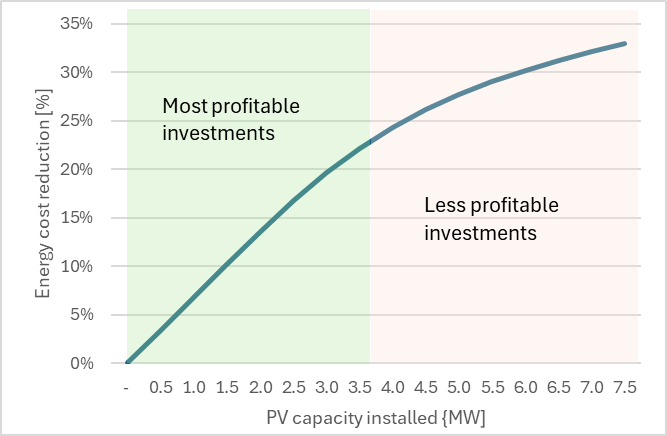 Figure 1: Profitability of solar-pv capacity installed
A data-driven analysis of solar-pv, BESS, and hybrid behind-the-meter systems under dynamic pricing, based on real EPEX Spot dayahead prices.
Across Europe, dynamic pricing is rapidly reshaping the economics of behind-the-meter energy systems. To help companies navigate these changes, we modelled three configurations under real hourly EPEX Spot intraday prices:
- Solar-pv-only
- BESS-only
- Hybrid (solar-pv + BESS)
The goal: determine when each technology delivers positive economic value, and when it doesn’t and find the optimal mix.
The opportunity: rising flexibility value behind the meter
New procurement options, greater price volatility and stronger electrification trends are increasing the value of flexibility. But companies often lack clarity on the real-world profitability of solar-pv, battery storage, or hybrid configurations under dynamic tariffs. This study provides a transparent, data-driven view of how distributed energy resources (DERs) like solar-pv and batteries, perform when price signals change hour by hour.
We focused on three core questions:
- Does solar-pv deliver economic value through self-consumption alone?
- Is BESS arbitrage profitable without additional services?
- Do hybrid systems unlock value that standalone assets cannot?
How we modelled “consumer reality”
Our simulation is built on realistic consumption and generation patterns, using actual hourly prices rather than fixed tariffs.
Key modelling inputs
-
Load profile: hourly residential consumption
-
solar-pv output: based on irradiance data for the Netherlands
-
Battery system:
- Sizes up to 6 MWh / 2 MW
- One-way efficiency: 94.47%
- Representative of small commercial-scale storage
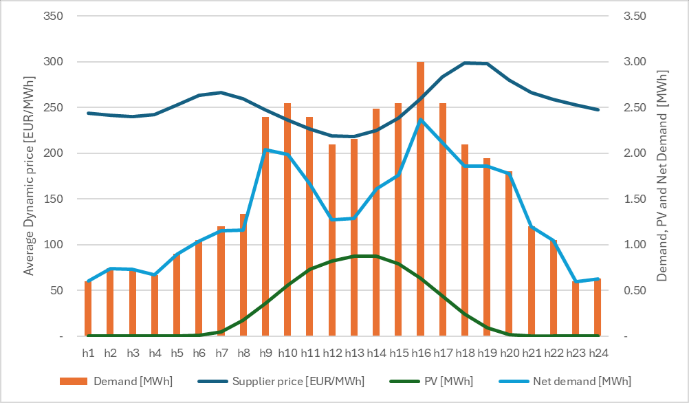 Figure 2: Average hourly consumption, generation and price patterns
Pricing structure
Instead of static tariffs, we used actual day-ahead EPEX Spot data, capturing:
- peak–off-peak spreads
- volatility
- negative-price events
- supply/demand-driven price spikes
solar-pv penetration scenarios
We varied annual solar-pv penetration across:
0%, 25%, 50%, 65%
This allowed us to test how much surplus solar-pv is available and how BESS performance shifts as solar increases.
| Solar-pv installed cap. [MW] | - | 0.50 | 1.00 | 1.50 | 2.00 | 2.50 | 3.00 | 3.50 | 4.00 | 4.50 | 5.00 | 5.50 | 6.00 | 6.50 | 7.00 | 7.50 |
|---|---|---|---|---|---|---|---|---|---|---|---|---|---|---|---|---|
| Solar-pv Energy [% demand] | 0.00% | 4.30% | 8.60% | 12.90% | 17.20% | 21.50% | 25.80% | 30.09% | 34.39% | 38.69% | 42.99% | 47.29 | 51.59% | 55.89% | 60.19% | 64.49% |
Table 1: Installed solar-pv vs % of demand
Profitability metric
We compared the EUR/MWh cost of consumption with and without DER assets — a simple and transparent measure of economic value.
Main findings: what the data tells us
The results show a differentiated picture: While solar-pv performs well under most conditions, BESS-only cases struggle. Hybrid systems only pay off at the right solar-pv penetration levels.
1. solar-pv only: consistently positive returns (but don’t export)
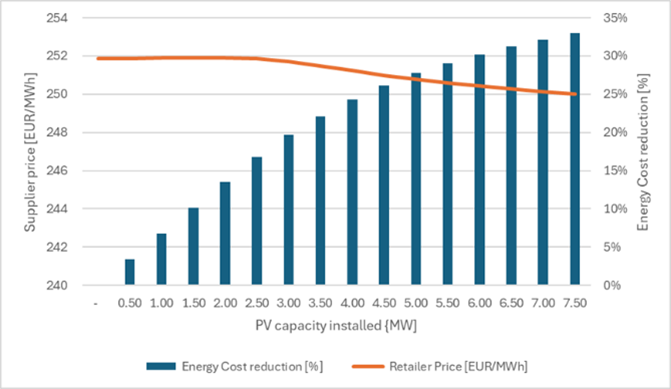 Figure 3: Energy cost reduction and Supplier price
solar-pv only systems generated stable value by offsetting grid consumption during daytime hours.
Key insights:
- Base-case annual cost without DERs: €3.57M
- solar-pv offsets supplier prices of €250–300/MWh
- solar-pv LCOE assumed €110–150/MWh
- Self-consumption is profitable
- Exporting is not: export price ~€50/MWh < solar-pv LCOE
When solar-pv production stays below on-site demand, the benefit is clear. But once solar-pv becomes oversized, the economics weaken due to low export prices.
2. BESS-only: arbitrage alone is not enough
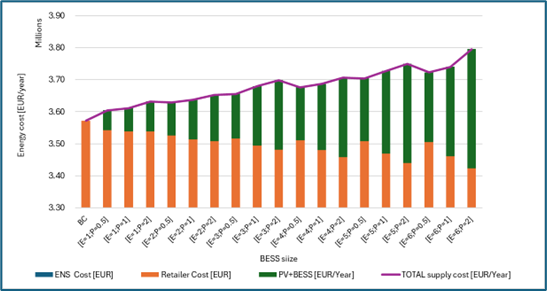 Figure 4: Supplier, ENS and BESS costs
The intuitive appeal of storage arbitrage, charge low, discharge high, is real. But at current spreads, the economics do not support a standalone BESS investment.
Findings:
- Annual cost without BESS: €3.57M
- With 6 MWh / 2 MW BESS: €3.42M (energy-only)
- But annualised BESS cost increases total energy cost to €3.79M
- Implied payback: ~24 years
This assessment excludes:
- congestion markets
- FTM ancillary services
- fiscal incentives
- imbalance revenues
In short: storage needs additional revenue streams to make sense on its own.
3. Hybrid solar-pv + BESS: strong value only at the right solar-pv size
The hybrid system is the most dynamic, and the most sensitive to solar-pv penetration.
At low solar-pv penetration
Battery utilisation remains limited due to insufficient surplus solar.
In these cases, adding BESS can actually increase total energy cost:
- Example: at 0.5 MW solar-pv, adding a 6 MWh / 2 MW BESS reduces benefit from 3.38% to 2.47%.
At moderate to high solar-pv penetration (50–75%)
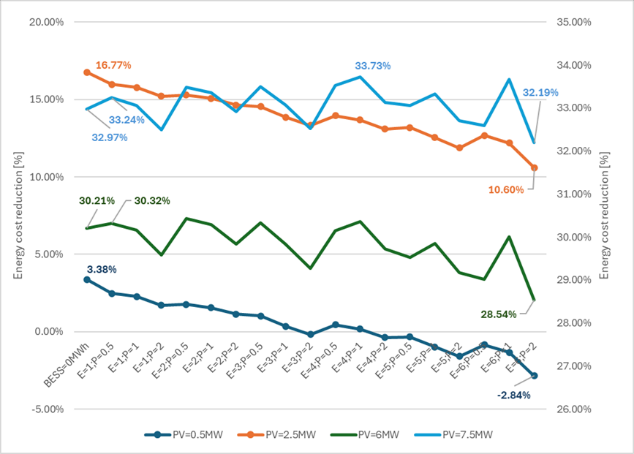 Figure 5: Supply cost under different PV capacities
BESS becomes a powerful complement:
- captures midday surplus
- shifts energy into the lucrative evening peak
- avoids unprofitable exports
- improves resilience to price volatility
This solar-pv range creates the optimal balance where storage adds real bottom-line value.
- Example: at 7.0 MW solar-pv, adding a 1 MWh / 0.5 MW BESS increases benefit from 32.97% to 33.24%.
At very high solar-pv overplanting
BESS absorbs excess production and significantly increases self-consumption, the most profitable use case in dynamic markets.
Conclusion
Dynamic pricing reshapes the value stack for behind-the-meter systems. Our analysis shows:
- solar-pv is almost always a good investment under dynamic tariffs
- BESS-only is rarely profitable without additional value streams like GOPACS and/or ancillary servcies)
- Hybrid solar-pv + BESS delivers strongest value only when solar-pv penetration is high enough
The most important lesson:
It’s not about buying a battery. It’s about sizing solar-pv and battery storage together, based on real price data.
If you want to explore how this applies to your site, operations or portfolio, our modelling team can support with a tailored assessment.
Contact us at hello@futuragrid.com