
The FuturaGrid manifest
FuturaGrid helps consumers reduce energy bills, overcome network congestion, and, wherepossible, generate additional revenue streams. We achieve this by providing technology‑agnostic assessments, capturing synergies across different technologies, and identifying the most profitable schemes for selling services to the system.
Context
Europe’s energy system is changing faster than at any time since the grid was first built.
The goals are clear: a fossil-free economy, a carbon-neutral power system and affordable, reliable energy for all. But while wind and solar capacity grow, the grid is reaching its limits. Across the Netherlands and the UK, thousands of companies face connection queues, delayed investments and lost growth. At FuturaGrid, we believe the future will not be delivered by governments or grid operators alone. It will be shaped by companies that take responsibility for their own energy destiny. This is our invitation to rethink the system together and to build one that is smarter, more flexible and more affordable.
The visual below summarises the journey: the fundamentals every business faces, the enablers that unlock control, and the tangible results companies can achieve
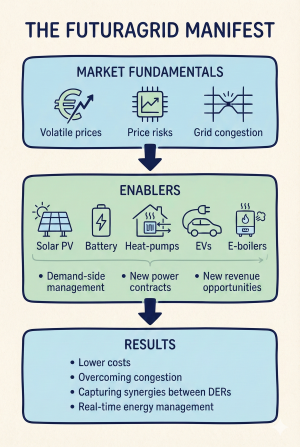 Figure 1: The FuturaGrid manifest
Market fundamentals
The forces you cannot control
Market fundamentals matter because they directly shape the business case for on-site energy assets. They determine where value emerges, where risks concentrate and why companies increasingly need their own modelling capability to make confident investment decisions
Decarbonisation is no longer optional
The global shift away from fossil fuels is an economic fact. Regulation, industrial decarbonisation pacts and corporate climate targets are redefining competitiveness. Early movers in electrification and clean energy gain long-term cost advantages, stronger brands and strategic resilience. So what? Companies that electrify early face lower long-term operating costs and avoid stranded assets
Energy independence as a new advantage
Recent gas shortages and price shocks have exposed Europe’s dependence on imported fuels. By producing and storing power on-site, companies can insulate themselves from external risks and secure greater control over cost and continuity.
So what? More control over sourcing means fewer budget shocks and fewer production interruptions.
Grid congestion is the new bottleneck
Unrestricted access to electricity can no longer be assumed. New connections are delayed and expansion plans are being paused. Electricity has become a constrained resource. This challenge is forcing a mindset shift: to grow or decarbonise, businesses must manage their own supply.
So what? Growth plans now depend on local flexibility and on-site solutions, not on waiting for grid reinforcement!
Enablers
The levers you can influence:
Smart technology puts control back in your hands
Solar panels, battery systems, EV chargers and microgrids are now practical, proven tools. The real question is timing: when does it make financial sense to invest? Technical complexity needs to be translated into clear, data-driven business cases that connect engineering reality with commercial logic. We don’t sell technology, we build truth. If a solution doesn’t pay back, we won’t dress it up to look profitable. Our assessments are holistic, not selective. We evaluate how every component interacts, because technologies that shine on their own can lose value when combined.
Only when the system as a whole works, do we call it a business case.
From self-consumption to system value
Distributed Energy Resources (DER) such as batteries, EVs, heat pumps and demand response systems, when combined with smart controls, help balance the wider grid. These balancing services are compensated by the System Operator, meaning your DER assets can generate revenue. Both on-site benefits and system services can create value. Quantifying these effects is essential to determine when investing makes sense.
Flexibility as a business opportunity
Adjusting demand has become a revenue stream.
Local flexibility markets and platforms like GoPACS reward companies that can modulate consumption or supply temporary capacity. Both on-site benefits and system services can create value. Quantifying these effects is essential to determine when investing makes sense.
From idea to bankable reality
Many promising concepts fail between feasibility and financing. Permits, grid studies, or insurance terms often derail delivery. FuturaGrid applies developer discipline early, validating grid capacity, technical compliance and permit readiness so every proposal can pass lender and insurer scrutiny.
Knowledge as the catalyst for change
Technology alone is not enough. Large corporates often have internal analysts; smaller firms usually do not. Clear knowledge is the catalyst for progress. FuturaGrid makes the complex understandable and transforms market data into clear decision paths.
Result areas
The value you create
- Lower cost: by using on-site generation and storage to buy less at peak prices.
- Operational continuity: avoid production interruptions caused by volatile prices or grid constraints.
- Higher margins or returns: by optimising when and how you consume, store and trade energy.
- Overcoming congestion: use on-site generation and storage to unlock electrification and growth
- Lower risk: insulate your operations from external shocks and price spikes.
- Resilience: lexibility becomes an asset that supports operations in tight conditions.
- Additional upside can come from participating in flexibility markets
FuturaGrid aligns technical, financial and behavioural levers so the energy transition becomes an advantage, not a cost.
The road ahead
The next phase is about using data, insight and discipline to turn uncertainty into decisions. Independent modelling, transparent assumptions and collaborative delivery make the first steps smaller and more manageable. The energy transition does not require perfect answers, only bold first steps. FuturaGrid exists to make those steps smaller, smarter and less risky through transparency, credible data and collaboration built on trust. When enough companies take control of their energy, the system evolves from the bottom up.
Closing words
FuturaGrid’s role is to provide clarity, not to push specific technologies. Companies need to understand when an investment pays back, when it doesn’t and which conditions make the difference. Our contribution is transparent modelling, grounded assumptions and a holistic view of how technologies interact, financially, technically and operationally The future of energy is not something that happens to your business, it is something you can shape. The next phase of the transition is about extracting the most value per megawatt. FuturaGrid designs value-optimised strategies so every kilowatt-hour delivers maximum benefit. The next wave of energy projects won’t be won by who installs the most megawatts, but by who captures the most value per megawatt. FuturaGrid exists to quantify and unlock that value for your site. We build a market powered by knowledge, technology and trust where every company can take control of its own energy future.